PNAS | Professor Chen Bing's Team Reveals the Molecular Mechanism of Bumblebees “Out of the Tibetan Plateau”
A recent collaborative study led by Professor Chen Bing's team from College of Life Sciences at Hebei University has unveiled a crucial part of this evolutionary puzzle. Using the fire-tailed bumblebee (Bombus pyrosoma), a species widely distributed in China, as a model, the research team employed an integrated approach combining genomics, physiology, and behavioral analysis. They discovered that chromosomal inversions, a special type of genomic structural variation, acted as a critical “engine” in the process of bumblebees adapting to different altitudinal environments and successfully expanding their range. Furthermore, this pattern of genomic variation was found to be prevalent across 22 other bumblebee species. The findings were published in the Proceedings of the National Academy of Sciences (PNAS). Dr. Jiang Chunyan and Lecturer Yue Lei from College of Life Sciences are the co-first authors, with Professor Chen Bing and Professor Huang Jiaxing from the Institute of Apicultural Research, Chinese Academy of Agricultural Sciences, serving as co-corresponding authors.
The research team conducted in-depth genomic analysis on 119 high-quality fire-tailed bumblebee samples, clarifying their origin and evolutionary history, and revealing that altitude drives their intraspecific genetic differentiation. The study confirmed that altitudinal gradient is a key factor driving genetic differentiation within this species. The research also found that chromosomal inversions are prevalent in high-altitude bumblebee populations and play a decisive role in their rapid adaptation to high-altitude environments. Through phenotypic validation and functional experiments, the team further confirmed significant phenotypic differences within the fire-tailed bumblebee species, characterized by specialization for “cold or warm environments.” Notably, the high expression of the fatty acid elongase gene elovl6 and the accumulation of its corresponding metabolic products effectively promoted the metabolic adaptation of high-altitude populations for flight in low-temperature environments, providing crucial molecular support for coping with high-altitude cold stress. This study not only systematically elucidates for the first time the central role of chromosomal inversions in the process of bumblebees “out of the Tibetan Plateau,” revealing a complete chain from genomic structural variation to physiological and behavioral adaptation, but also provides valuable new insights for understanding the formation of global alpine biodiversity. With climate change, the survival of alpine species faces challenges, and understanding their genetic “toolkit” for environmental adaptation is crucial for future biodiversity conservation.
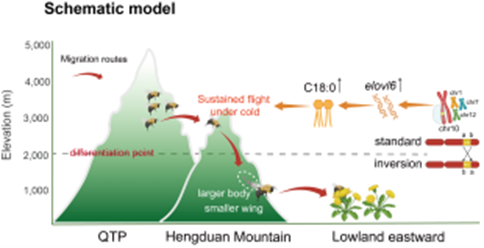
Diagram showing chromosomal inversions promoting altitudinal adaptation in fire-tailed bumblebees and their dispersal out of the Tibetan Plateau.
Paper Link: https://doi.org/10.1073/pnas.2513080122
(Contributed by the College of Life Sciences and Institute of Science and Technology Innovation)